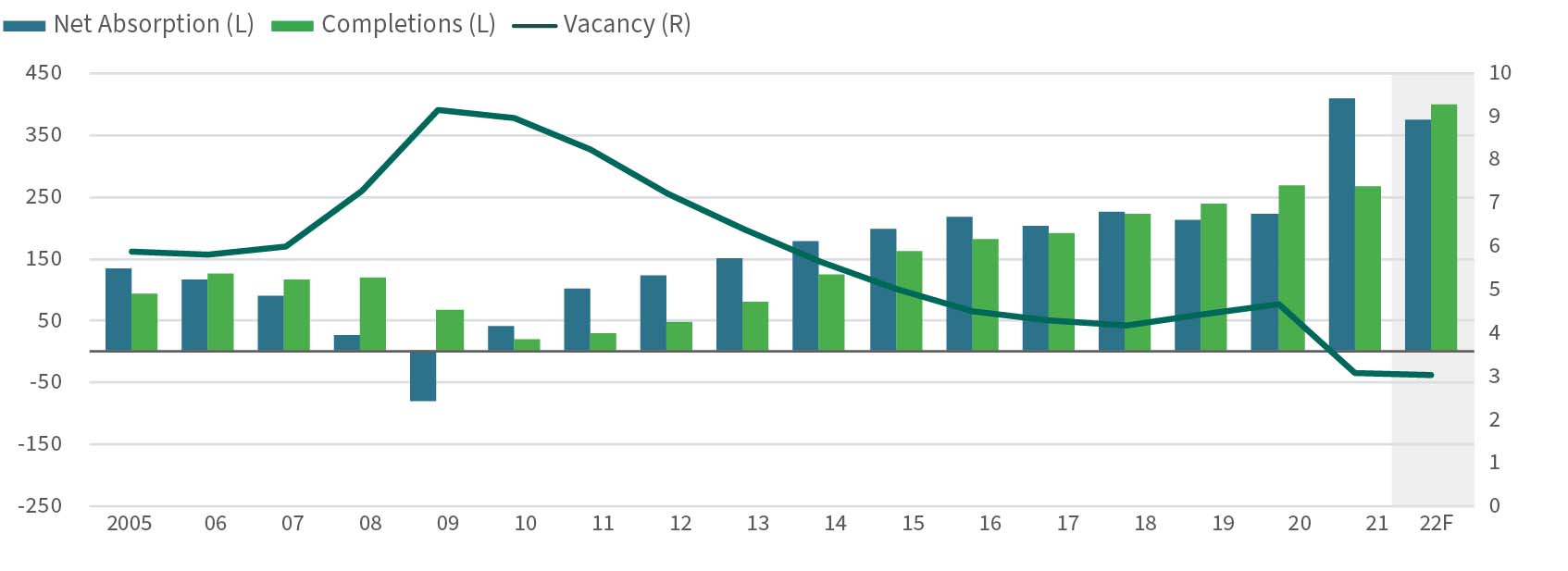
- Low supply will continue to drive competition for space. Of the 390 MSF of construction now in the pipeline, most will be spoken for upon delivery given current pre-leasing volumes. Some 70 percent of new supply is pre-leased.iv
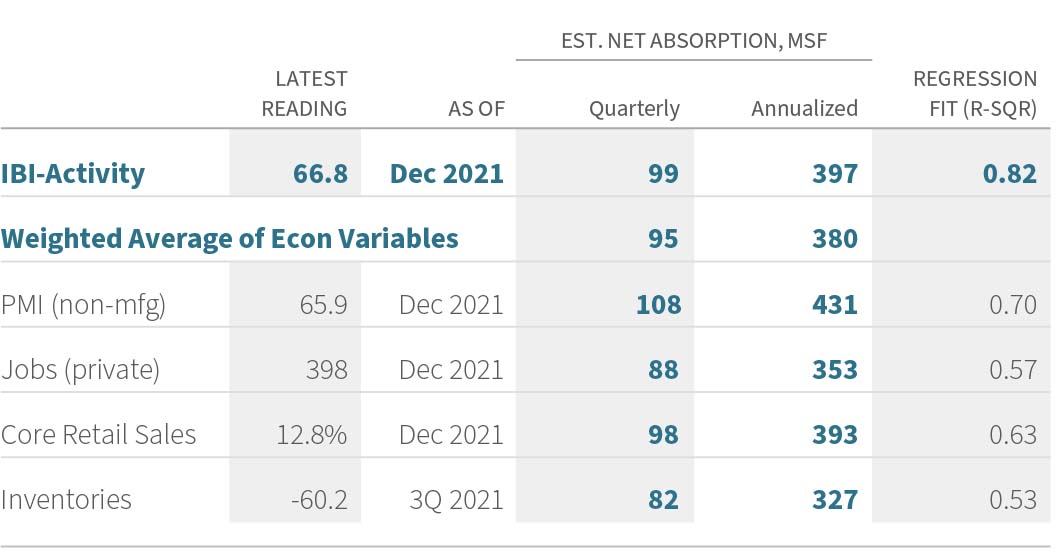
- Increased consumption lifted warehouse demand. Despite backlogs, supply chains remained active through the holidays. The Q4 IBITM activity index was 66.8, up 120 basis points quarter-over-quarter. This level of activity is estimated to create approximately 400 MSF of demand for logistics space over the coming year. During the holidays, e-commerce sales – which require three times the logistics real estate of traditional brick-and-mortar stores - rose 11 percent year-over-year vs 8.1 percent in-store.v
- Space utilization points to ongoing logjams in the supply chain. The utilization rate edged up into the mid-85 percent range in November and December. While utilization is below its historic high of 87 percent, the inventory-to-sales ratio is more than 10 percent below pre-pandemic levels and there is no “shadow space” to absorb inventory right-sizing. Prologis believes supply chains will have to expand by 15 percent or more to accommodate normal inventory levels and foster resilience against future disruptions.
- Vacancies will remain at historic lows through 2022. Prologis Research forecasts net absorption of 375 MSF and completions of 400 MSF, which will keep vacancy at its historic low. U.S. market rents should increase by another 10 percent in our base case. We expect that supply chain disruptions will persist into 2023, which could amplify competition for even fewer vacant space. As we’ve noted before, logistics customers who move quickly to secure prime space in this tight market will reap the competitive advantage.
Exhibit 3
SUMMARY OF NET ABSORPTION INDICATORS
Note: Values are a 3-month trailing average, except inventories. Stock, absorption, completions, under construction and vacancy fundamentals now represent a narrowed 30 markets to reflect where Prologis has a presence.
Source: Institute of Supply Chain Management, Bureau of Economic Analysis, U.S. Census, Bureau of Labor Statistics, Prologis Research.
Exhibit 4
MARKET FUNDAMENTALS, U.S.
MSF
Source: CBRE, JLL, Cushman & Wakefield, Colliers, CBRE-EA, Prologis Research.