
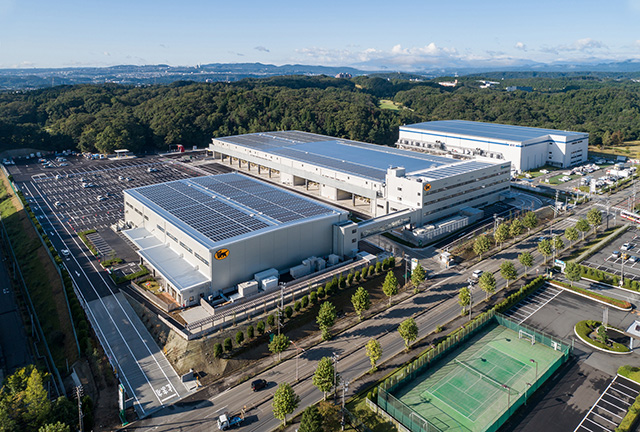
Wide angle view of a data center landscape

Prologis Announces Responsible Data Center Development Commitments

Published on

Introduction

Data centers support the technology people and businesses rely on every day, from processing credit card payments to giving doctors digital access to patients’ medical records. As data center demand grows, communities and public officials are asking fair questions about power, water, local infrastructure and community benefits.

For more than 40 years Prologis has invested with a clear focus on responsibility, reliability and long-term commitments to communities. We support clear, consistent and timely standards that help distinguish well-planned projects and give communities confidence in how growth is managed.

To help communities understand who Prologis is as a developer and community partner, we published our Responsible Data Center Development Commitments, covering how we approach power planning, water use, environmental impact, community engagement, local benefits and accountability for every project. 

Content Above Blog Author

1. Protect ratepayers by planning and paying our fair share 

We will study power needs early, before a project moves too far in the development process. We will work with utilities, grid operators and public officials to identify the infrastructure needed to serve the project. Where upgrades are driven by our project, we will work through applicable utility processes to ensure those costs are identified and appropriately allocated, with the goal of protecting existing ratepayers.

Related: Prologis recently signed the White House Ratepayer Protection Pledge, which calls on large data center operators to fund the power generation and grid infrastructure their projects require rather than shifting those costs to existing ratepayers.

2. Use water responsibly

We will evaluate local water conditions before advancing a project and design data centers to minimize water use. Our standard approach will prioritize closed-loop cooling systems that significantly reduce ongoing water demand. Where local conditions, customer requirements or technology needs call for a different approach, we will evaluate air-cooled, recycled water, non-potable water or other efficient solutions that reduce reliance on drinking water. We will explain our water approach in plain language during the local review process.

Fast fact: Closed-loop cooling systems use roughly the same amount of water per building each day as a single car wash.

3. Be clear about backup power 

Data centers need backup power to operate reliably. We will explain how backup power is expected to be used, including testing, emissions controls and applicable permitting requirements. Where practical, we will evaluate cleaner or lower-impact options as technology and local infrastructure allow. 

4. Reduce environmental impact 

We will evaluate greenhouse gas emissions and other environmental impacts as part of project planning. We will identify feasible ways to reduce those impacts through design innovation and engaging our customers and connect this work to Prologis’ goal to achieve net zero by 2040. We will be transparent about what can be addressed at the project level and what depends on broader energy infrastructure.  

Zoom in: We use whole-building life cycle assessments early in the development process to estimate greenhouse gas emissions associated with building materials and operations. Then, we find ways to reduce emissions through design and material choices. We also apply an internal carbon price to every project reviewed by our Investment Committee, ensuring carbon impacts are weighed alongside cost and performance. 

5. Design with neighbors in mind

We will plan sites with attention to the surrounding community. That includes using setbacks, screening, landscaping and building placement to reduce noise and visual impact. We will also manage construction activity with clear expectations for traffic, site access and working hours.

6. Regularly engage with communities

We will continue to engage with elected officials and community members to share information, answer questions and understand local priorities. For major projects, we will provide public materials and a dedicated way for people to contact us. Community engagement should not start at the end of the process.  

Related: We weighed in Governor’s Abbott’s recent announcement for enhanced review of data center projects in Texas focused on grid reliability, ratepayer protections, water stewardship and community impacts. We support this measured path, which strengthens oversight while allowing investment and dialogue to continue.

7. Explain benefits clearly 

We will explain the expected local benefits of each major project in simple terms. That includes jobs, tax revenue and community investment. We will avoid inflated claims and focus on information that communities can understand and evaluate.

By the numbers: The potential benefits can be significant: The Data Center Coalition reports that individual data centers generally support dozens to hundreds of direct jobs and employ hundreds of construction workers—sometimes more than 1,000 at peak construction. Nationally, a PwC analysis found that the U.S. data center industry contributed $204 billion in local, state and federal taxes in 2024.

8. Follow through on commitments 

For major data center projects, we will document the commitments we make during the development process. This may include commitments related to site design, traffic management, energy infrastructure, water use or community engagement. We will make it clear who is responsible for follow-through.  

When we commit to our communities, we deliver. For example, at International Park of Commerce in Tracy, California, we invested more than $250 million in surrounding infrastructure, including 31 lane miles of new roads, a new bridge, upgraded utilities, a 1-million-gallon water tank and a 30-acre public park.

We took the same approach with our 2025 sustainability commitments. We set measurable goals, reported progress and delivered. And, we’re taking the same disciplined approach with data centers. 

To learn more about our approach visit https://www.prologis.com/real-estate/development/data-centers

Chris Curtis

Chris Curtis

Position
Global Head of Data Centers, Prologis

Chris Curtis serves as global head of data centers at Prologis. In addition, Chris serves on the Data Center Coalition Board and the Urban Land Institute (ULI) Data Center Product Council. A seasoned data center expert, Chris brings more than 5 gigawatts of data center development experience across the U.S., Canada and Europe. Before Prologis, Chris co-founded Compass Datacenters, where he led all development projects from 2011 to 2023. Prior to that, he spent a decade developing high-security, build-to-suit projects for U.S. Federal Government agencies.