Secondary menu

  • Customer Login
  • Investor Relations
  • Contact Us
Home Prologis
  • Real Estate
    Available Property Search
    Search Properties Near You
    • Column 1
      • Browse Properties by Region
        • Americas
        • Europe
        • Asia
    • Column 2
      • Real Estate Operations
        • Simplified Leasing
      • Development and Acquisitions
        • Build-to-Suit
        • Data Centers
        • Speculative Development
        • Sustainable Development
  • Essentials Solutions
    • Column 1
      • The Essentials Platform
      • Operations
        • Warehouse Consulting & Strategy
        • Move-In & Move-Out
        • Material Handling Equipment & Storage
        • Infrastructure
        • Automation & Robotics
        • Software & Technology
        • Security
        • Transportation
        • Workplace & Productivity
    • Column 2
      • OnDemand
        • OnDemand Power
        • Fleet Electrification
        • Workplace Charging
        • Hubs
      • Energy & Sustainability
        • Grid-Scale Energy Storage
        • Commercial and Industrial
        • Community Solar
      • Workforce
        • Instawork
  • Insights and News
    • Insights and News
      • Research
      • Blog
      • Industry Trends
      • Success Stories
    • GROUNDBREAKERS™
      • Magazine
      • Moving the World Podcast
  • Impact
    • Impact & Sustainability
      • Sustainability
      • Social Impact
    • Governance
    • Additional Resources
    Warehouse roof showing solar panels

    2025-26 Report

  • About
    • Column 1
      • About Us
        • Leadership and Board of Directors
      • Careers With Us
        • Culture and Talent
        • Open Positions
      • Investors
        • Strategic Capital
        • Investor Relations Site
    • Column 2
      • Prologis Ventures
      • News & Press Releases
        • Media Center
        • Awards
You are currently on the Prologis global website
  • Global
    • www.prologis.com
      • en
  • Americas
    • Brazil
      • pt
      • en
    • Canada
      • en
    • Mexico
      • es
      • en
    • USA
      • en
  • Asia
    • China
      • zh
      • en
    • India
    • Japan
      • jp
    • Singapore
      • en
  • Europe
    • Belgium
      • nl
      • fr
      • en
    • Czech Republic
      • cs
      • en
    • France
      • fr
      • en
    • Germany
      • de
      • en
    • Hungary
      • hu
      • en
    • Italy
      • it
      • en
    • Netherlands
      • nl
      • en
    • Poland
      • pl
      • en
    • Slovakia
      • sk
      • en
    • Spain
      • es
      • en
    • Sweden
      • se
      • en
    • UK
      • en
View Prologis Office Locations

Secondary menu

  • Customer Login
  • Investor Relations
  • Contact Us
Search Properties Near You
Global websites You are currently on the Prologis global website
  • Global
    • www.prologis.com
      • en
  • Americas
    • Brazil
      • pt
      • en
    • Canada
      • en
    • Mexico
      • es
      • en
    • USA
      • en
  • Asia
    • China
      • zh
      • en
    • India
      • en
    • Japan
      • jp
    • Singapore
      • en
  • Europe
    • Belgium
      • nl
      • fr
      • en
    • Czech Republic
      • cs
      • en
    • France
      • fr
      • en
    • Germany
      • de
      • en
    • Hungary
      • hu
      • en
    • Italy
      • it
      • en
    • Netherlands
      • nl
      • en
    • Poland
      • pl
      • en
    • Slovakia
      • sk
      • en
    • Spain
      • es
      • en
    • Sweden
      • se
      • en
    • UK
      • en
View Prologis Office Locations

Breadcrumb

  1. Home
  2. Insights and News
  3. Accelerating the Shift to Zero-Emissions Fleets: Your Guide to a Smooth Transition
Mobility Bridge

Mobility

Accelerating the Shift to Zero-Emissions Fleets: Your Guide to a Smooth Transition

Published on April 17, 2024
    • Copy Link
      Copied!
    • X
    • LinkedIn

    Introduction

    Logistics fleet owners and operators are at the epicenter of a significant shift in the global supply chain as net-zero targets become a key priority. This critical transition demands the decarbonization of our transportation systems that direct the flow of goods. Electrified fleets—long-haul trucks, delivery trucks and utility vehicles—are an integral aspect of the shift because transportation is currently responsible for 30% of global emissions. 1

    To transition successfully, understanding the challenges and opportunities ahead is imperative to set achievable objectives, clear timelines and expectations. But what does zero emissions really mean for you as a logistics fleet operator? It means embarking on a journey that’s about more than meeting environmental targets—a process that promises operational efficiency, cost savings and reduced complexity throughout the transition.

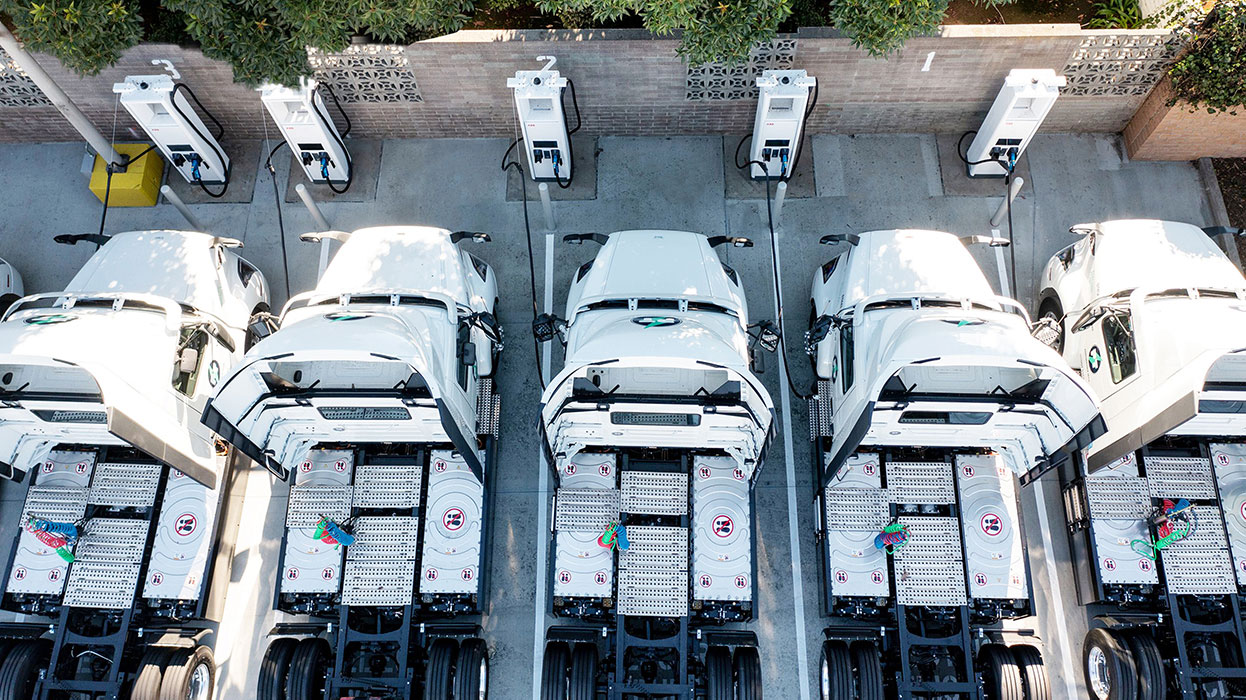
    EV Fleet Trucks

    Define success with achievable goals

    Goal setting is perhaps the most crucial step to transition to zero emissions successfully. The best approach is to define your driving influences and objectives and then articulate the desired outcomes of your transition. In some instances, fleet transition may be motivated by corporate sustainability goals, while other timelines and benchmarks will be influenced primarily by compliance with regulatory requirements. With this in mind, consider your organization's overall net-zero strategy and align your fleet electrification efforts with those objectives. With specific targets established, you can determine where to start with your electric vehicle (EV) fleet and set realistic deadlines to achieve your goals.

    Examples of targets might include reducing the tons of tailpipe carbon dioxide your fleet produces each year, committing to a specific number or percentage of EVs in your fleet within a given time frame, achieving a net-zero fleet across a percentage of routes, or aligning to broader corporate sustainability targets set for 2030, 2035 or even 2040. For instance, you could aim to have 20% of your fleet transitioned to EVs by 2025, resulting in a projected 15% reduction in tailpipe CO2 emissions. Similarly, another goal could be to have at least 50% of your established routes covered with a net-zero fleet by 2030. Specific and measurable objectives provide clear direction for your EV fleet transition, keeping you on track with both environmental compliance and your organization's broader sustainability strategy.

    Align Your Goals With Regulations and Incentives as a Guide

    The regulatory landscape for EV fleets is evolving rapidly as local, state and federal governments continually introduce new standards. For instance, in California, full EV conversion for drayage operations must be completed by 2035.2 Below are additional examples:

    • California recently implemented a rule prohibiting the sale of diesel trucks and buses after 2036.3
    • The Inflation Reduction Act offers a substantial $40,000 tax credit for electric trucks over 14,000 pounds, among other incentives, to accelerate the adoption of EV fleets.4
    • The Advanced Clean Fleets Regulation (ACF) in California aims to ensure air quality standards and climate goals apply to every kind of logistics fleet vehicle.
    • Santa Monica conducted a pilot program in 2022 for a zero-emissions delivery zone, granting priority curb access to electric vehicles.

    Tie your goals to the regulations and incentives based on where you operate and discover your options and guidelines by leveraging expert resources.

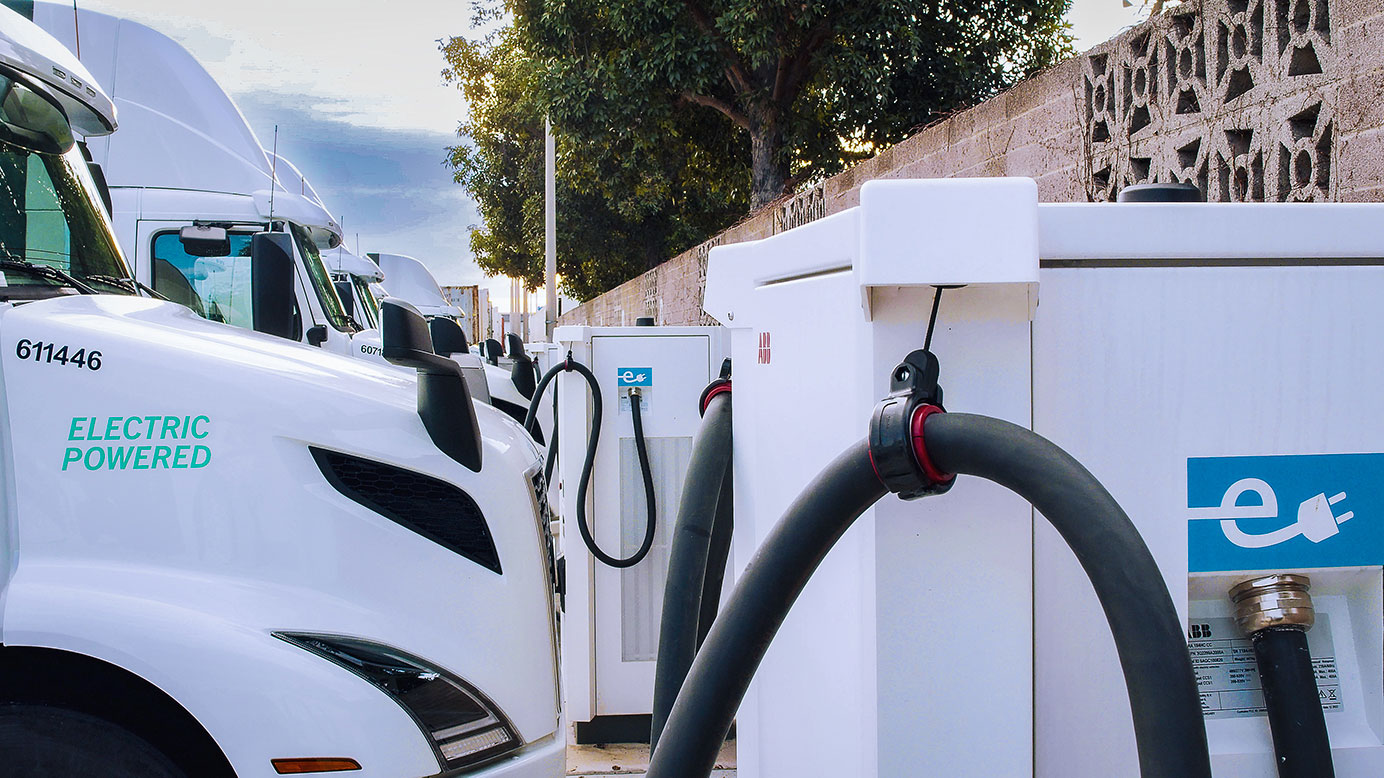
    Fleet of trucks charging

    Map Your Transition With Realistic Timelines

    Recognizing realistic timelines is vital for a seamless transition to zero-emissions fleets. The shift will be a gradual process, not a one-time event, because of continuous evolution in the industry, equipment and infrastructure. You can tackle this complex situation in three ways:

    1. Contact a trusted expert who can map market-specific timelines for electrification. 
    2. Work with solution providers who can supply technologies that expedite the deployment of your EVs. 
    3. Partner with companies that have the scale, expertise and network to ensure your electrification roadmap meets your budget, reliability and timeline expectations.

    A project involving site planning, permitting, construction, installation and utility interconnect typically takes nine to 13 months from initial plans to installation and activation.5 Given the state of the supply chain, potential scale, complexity of solutions and urgency in the industry to reach net-zero, it’s possible that acquiring and fully deploying a fleet, and getting the necessary utility power to a charging site, can take closer to 18 to 36 months.6 In cases where faster deployment is required, temporary power, energy storage and microgrids are solutions that an expert partner can help you navigate. Strategic planning for each element of the process ensures a successful outcome.

    EV trucks charging

    Operationalize with infrastructure in mind

    Successful fleet electrification requires a foundation of robust infrastructure, but the present state of public charging infrastructure has room for improvement. It falls short of meeting 97% of the demand and suffers from reliability issues, which poses three significant challenges: lack of ownership, limited accountability and workforce constraints. Without a clear owner, accountability for an infrastructure's functionality can be unclear. And without a dedicated workforce, repairs and regular maintenance are often overlooked. Commercial fleet charging presents unique requirements. It's not just about having enough chargers; it's about ensuring reliability. To achieve that, there are four primary options:

    Build your own infrastructure. This requires significant capital investment, but it offers full control over all aspects of the charging infrastructure. The downside, however, is that building your own infrastructure necessitates developing expertise in a non-core business area, managing multiple entities related to maintaining the infrastructure, and depending on a third-party workforce for service and upkeep.

    Partner with multiple vendors. Similar to building your own infrastructure, partnering with several third parties to construct, install and look after infrastructure offers a degree of control, but it also presents the same disadvantages.

    Work with a turnkey provider. Collaborating with a turnkey provider streamlines the process because they design, build, install, and maintain chargers and infrastructure for the lifetime of the charging network. A comprehensive solution like this allows you to focus on your core operations.

    Use offsite charging hubs. Offsite charging hubs, located near key logistics regions, bypass the need to manage charging infrastructure directly and allow fleets to recharge on the go. A subscription-based solution is a hassle-free choice.

    Each option depends on your specific needs and abilities. No matter which direction you choose, a trusted partner with expertise in sustainable logistics and real estate will prove invaluable to navigate the complexities of transitioning to electric fleets.


    Your drive to zero emissions begins here

    As we strive to reduce greenhouse gas emissions and achieve net-zero goals, electrifying fleets plays a pivotal role in the transition to more sustainable operations. By setting clear objectives, quantifying carbon reduction potential, establishing realistic timelines and planning the necessary infrastructure, you can guide your organization through the shift to electric fleets. Embracing zero-emissions transportation not only helps achieve your net-zero goals, it also positions your organization as a leader in sustainability.

    Endnotes

    1. McKerracher, Colin, et. al. Electric Vehicle Outlook 2023, BloombergNEF, 2023.
    2. “CARB Fact Sheet: 2023 Advanced Clean Fleets Regulation - Drayage Truck Requirements“ California Air Resources Board.​​​​
    3. Austin, Sophie. “California Approves Rule Phasing Out Big Diesel Trucks“ The Associated Press.​​​​
    4. Agrawal, Shreya. “The Future of the Trucking Industry: Electric Semi-Trucks“ Environmental and Energy Study Institute.​​​​
    5. Buholtz, Travis, et al. “Electrifying Freight: Pathways to Accelerating the Transition“ Electrification Coalition, 2020.​​​​
    6. “Commercial Fleet Electrification: Misconceptions, Challenges, and How To Move Forward“ Momentum Fleet Management Group.​​​​

    Prologis Essentials

    At Prologis, we draw from 40 years of owning and operating logistics real estate to provide you with future-forward solutions that keep your product moving at the speed of your business. With dedicated experts who handle everything—from design, engineering, procurement, permitting and installation—we are your single point of contact to accelerate your drive to zero-emissions logistics.

    Please enter your information
    *Required Information
    Click here if you agree to receive marketing communications via email by Prologis. Our communications may include news, surveys and communications from Prologis, which may include information about our partners' solutions.


    By submitting this form, you acknowledge that you have read and agree to the Terms of Use and Privacy Policy.

    Up Next

    Semi Truck Driving Sunrise
    Mobility

    Electric Fleet Management Software: Demystifying the Digital Overhaul of Fleet Operations

    Published on April 17, 2024
    Solar Panels Growth Renewable Energy
    Mobility

    The Growth of Renewable Energy in the Commercial and Industrial Sector: A Strategic Imperative

    Published on April 17, 2024
    Home

    Footer

    • Real Estate
      • Essentials Solutions
      • Insights
      • Sustainability
      • About
    • Customer Login
      • Investor Relations
      • Contact Us
    • Privacy Policy
      • Terms of Use
      • Accessibility Statement
      • For Employees

    Footer social links

    • Decorative Link
    • Decorative Link
    © 2026 Prologis, Inc. All rights reserved.