Aerial view of Prologis Park Born DC1

Bold Predictions for 2026: Supply Chain Trends to Watch

Published on

Introduction

Prologis Research tapped into decades of industry experience, proprietary data, and unique property and customer insights to predict seven supply chain trends for 2026.  

Bold Predictions for 2026

  1. International markets will outperform: Europe’s vacancy rate will drop below 5%, Brazil will see double-digit rent growth for the fourth consecutive year and India will enter a development and leasing boom driven by logistics modernization.
  2. Demand in gateway U.S. markets will reach a three-year high, driven by absorption of modern Class A logistics space.
  3. U.S. warehouse utilization will reach expansionary levels as customers max out current space and start new leases.
  4. E-commerce companies will near 25% of new leasing in 2026 as the proportion of goods sold online rises to almost 20% globally by year-end.
  5. The need for power-ready logistics facilities capable of supporting automation and manufacturing will be a top three factor globally in location selection in 2026.
  6. Defense-related demand in the U.S. and Europe will breathe new life into older industrial corridors and produce a new class of specialized logistics assets.
  7. Shrinking trucking capacity will drive double-digit rate hikes in 2026, making transportation an even larger share of total supply chain spend and amplifying the value of well-located logistics real estate. 
  1. International markets will outperform: Europe’s vacancy rate will drop below 5%, Brazil will see double-digit rent growth for the fourth consecutive year and India will enter a development and leasing boom driven by logistics modernization.
  • Europe will maintain its position as one of the tightest logistics markets globally, with a low speculative pipeline, targeted development embargoes, elevated development costs and municipal restrictions that will temper new starts. A growing leasing pipeline in late 2025 will translate to absorption in 2026,1 and the vacancy rate will decline as fewer new buildings come online.
  • In Brazil, rent growth is forecast to remain among the highest globally. Vacancy in the key Prologis markets of São Paulo and Rio de Janeiro has declined to a decade low of 8.5%1 and is expected to fall further. Competition for increasingly scarce modern stock will drive up the value of existing product and be a key advantage for developers able to navigate the Brazil market.
  • India is set for accelerated development of modern logistics infrastructure, although developers will need to navigate a challenging land-procurement market. Backed by institutional capital and rising occupier expectations for speed and efficiency, new supply will help expand regional logistics networks and serve a growing and underserved consumer base, improving intranational connectivity as supply chains move beyond India’s primary metropolitan areas. 
  1. Demand in gateway U.S. markets will reach a three-year high, driven by absorption of modern, Class A logistics space.
  • As logistics networks evolve in response to both cost pressures and service expectations, coastal markets will become more attractive. Markets like the Inland Empire and New Jersey are poised for a demand recovery, with access to dense population centers, improved availability of modern stock and rents that have adjusted to more sustainable levels. Looking ahead, these conditions will allow for increased demand as customers shift inventory closer to consumption to mitigate transportation costs and improve service levels.
  • Rent premiums that expanded significantly during the pandemic have since compressed, improving the price-to-value ratio for logistics occupiers. The spread between rents in these markets and the rest of the U.S. in the second half of 2025 have returned to pre-pandemic levels. This recalibration has restored relative value for customers seeking to maintain coastal access while controlling occupancy costs. 

  1. U.S. warehouse utilization will reach expansionary levels as customers max out current space and start new leases.
  • Warehouse utilization rose in 2025 but remained below the expansionary level of 85.5%.2 Growth has been led by users in essential goods, e-commerce and manufacturing. Wholesale and manufacturing customers frontloaded inventory in early 2025, driving utilization upward, with retailers following as they shifted inventories ahead of the holidays.
  • Given the current pace of expansion, customers are on track to reach functional capacity in 2026. The current trajectory mirrors prior periods of rapid reabsorption, including 2014–2015 and 2021–2022, when utilization rebounded sharply following elevated vacancy and logistics slack. With excess space worked out of the system, more users will return to net growth for their logistics footprints.

  1. E-commerce companies will near 25% of new leasing in 20261 as the proportion of goods sold online rises to almost 20% globally by year-end.3
  • E-commerce companies are adapting their regional diversification strategies. Global e-commerce penetration is expected to reach 19.7% by 2026.3 Asian e-commerce players that initially focused on U.S. growth through a combination of direct leases and 3PL partnerships are now expanding their networks into Europe and Latin America to support cross-border fulfillment.
  • Meanwhile, major international players like Amazon continue to expand across Europe, and Mercado Libre maintains its leadership in Latin America. In India, Flipkart and Walmart are increasing their distribution capacity to meet rising domestic and export demand. In the U.S., the model is evolving: de minimis changes are driving e-commerce companies to shift toward blended strategies involving onshore inventory positioning, sea-cargo cross-docking and rapid regional fulfillment.

  1. The need for power-ready logistics facilities capable of supporting automation and manufacturing will be a top three factor globally in location selection in 2026.
  • Power availability is rapidly becoming a critical factor for leasing and will continue to climb the list of customer priorities, particularly as facilities with the best access are leased up and fewer new buildings are delivered. In Europe, developments are constrained by grid delays and connection caps, driving the need for micro-grid solutions. In Mexico’s manufacturing-led markets, lack of power supply for tenants moving into new facilities is already the top constraint,4 and transformer utilization across all major manufacturing hubs exceeds the recommended 80% threshold.5 Constraints are also acute in the United States: In the San Francisco Bay Area, we estimate that only 2% of transformation substations have available firm capacity.6 This shift reflects both rising demand and tightening supply across key markets for global supply chains.
  • Power requirements for logistics users continue to increase, not just in advanced manufacturing segments and data centers, but for traditional logistics uses as well, as automation, HVAC and new technologies add to energy requirements. Looking ahead, we expect energy consumption to rise further: Fully automated facilities use 3–5x more power than the 2024 vintage baseline.7
  1. Defense-related demand in the U.S. and Europe will breathe new life into older industrial corridors and drive a new class of specialized logistics assets.
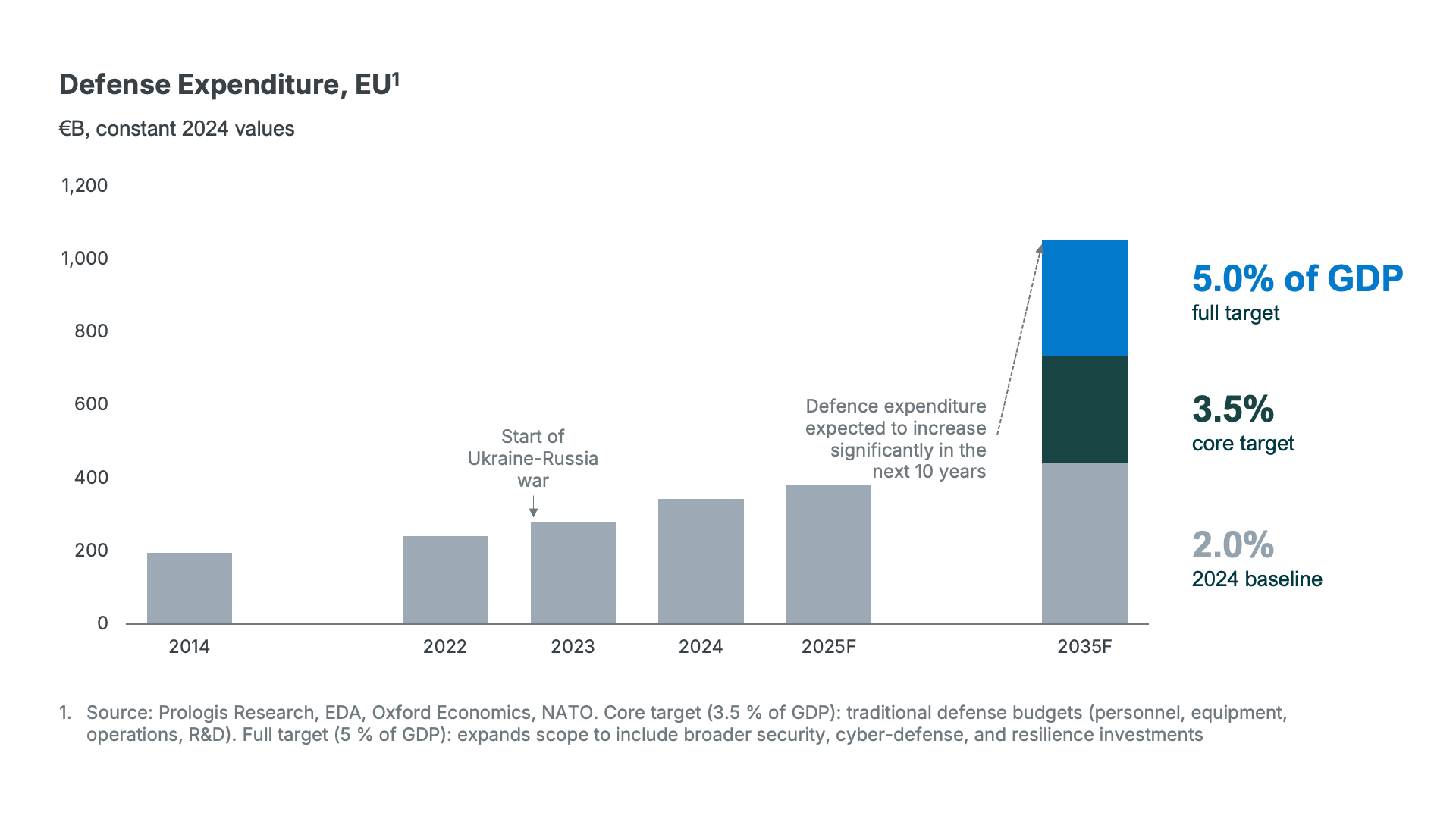
  • Defense-related logistics demand is in the early stages of adjusting to new dynamics. European nations are committing to raise defense spending to 5% of GDP, up from an average of 2.5% in 2024.8 Investment will cluster in strategic industrial corridors and cost-effective secondary hubs benefitting markets such as Germany, France, Italy, the UK, the Netherlands and Poland.
  • In the U.S., elevated Department of Defense spending should support steady demand, with activity expanding beyond large prime contractors as defense technologies evolve. A growing number of small and midsize defense suppliers are entering the market and leasing industrial space to support localized, secure supply chains. In 2024, Los Angeles County received the most defense funding in the U.S. with its deep aerospace manufacturing base, followed by Fairfax County in Virginia.4
  • Across both regions, these customers may require highly specialized facilities that can support advanced manufacturing. This is driving users towards facilities with existing high power and manufacturing specs, often older product built during prior manufacturing booms. 
Defence expenditure graph
  1. Shrinking trucking capacity will drive double-digit freight hikes in 2026, making transportation an even larger share of total supply chain spend and amplifying the value of well-located logistics real estate.
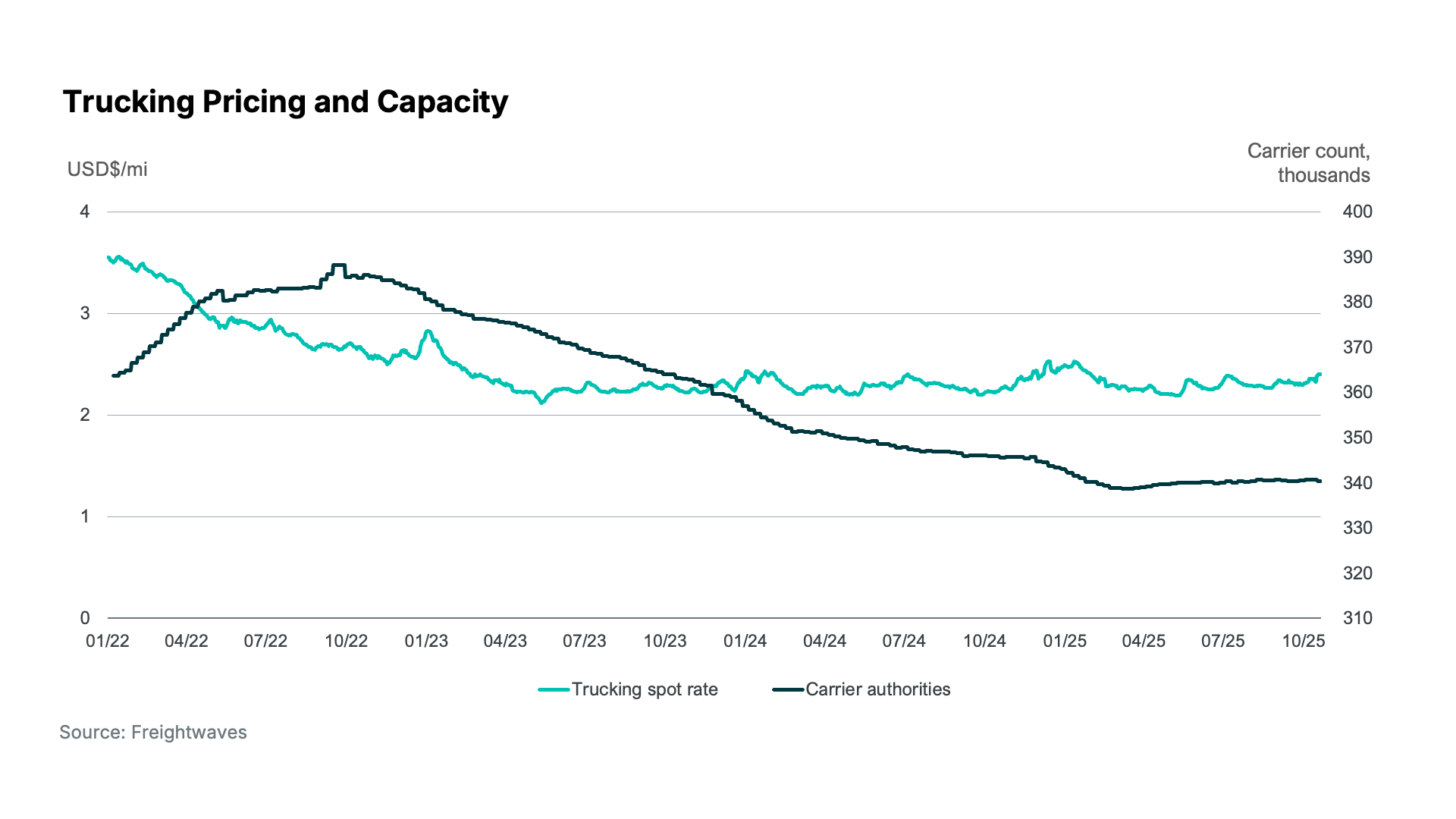
  • The number of U.S. truckers is shrinking at an accelerating pace as the freight recession enters its third year and new regulations, such as the English language requirement, force some out of the industry. Smaller carriers in particular are under pressure from rising costs and the expiration of pandemic-era relief loans, with the number of active carrier authorities 12% below the 2022 peak and falling.9 Market signals reflect tightening conditions. National tender rejection volumes are 136 basis points above 2024 levels and forecast to rise, which tends to correspond to rising rates. Spot rates are up 4% versus the 2024 average, with further increases expected into 2026.9
  • With freight costs up 3.5% in 2025, upward pressure is set to extend into 2026.10 If demand remains subdued, carrier attrition, tightening driver availability and ongoing regulatory constraints will drive transportation to the center of shippers’ cost management strategies. This dynamic amplifies the value of well-located logistics real estate that can shorten delivery distances, reduce transit times and help offset rising transport costs.
Trucking Pricing and Capacity

What Did We Get Right and Wrong in 2025?

Prologis Research got 6/7 predictions correct in 2025, even amid a surprising policy environment.

South America’s turn to take the stage: Brazil’s logistics real estate rent growth will surpass the global average by more than 500 bps as vacancy rates fall to never-before-seen mid-single digits.

  • 2025 rent growth in Brazil is estimated at 11.5% compared to -4.6% globally, a beat of ~162 percentage points, as e-commerce demand in Brazil remains robust.
  • The vacancy rate fell to 8.5% in Q3 20251—the lowest level in more than a decade— and is expected to decline further to the mid-7% range by year-end as demand for modern stock drives occupancy. 

All quiet on the construction front: Groundbreakings of logistics real estate buildings will decrease further in 2025, remaining 15% below normal globally. 

  • With replacement and financing costs remaining high, and ever-increasing regulatory barriers to entry, global starts have averaged just under 100MSF per quarter, ~20% below normal.1 

California’s domino effect: New legislation will seek to limit new supply in key locations. Following the passage of State Bill AB98 in California, we expect other states to propose similar measures in 2025. 

  • New Jersey, New York, Oregon and Washington are among the states that have proposed bills similar to AB98 that aim to curb the construction of new logistics facilities, although all bills have yet to be enacted. 

Better together: Freight industry consolidation will accelerate. M&A activity will intensify and drive technology investment and the next wave of expansion. 

  • In the first half of 2025, the transportation and logistics sector recorded 93 announced M&A deals totaling $57.9 billion, up from $49.2 billion in late 2024.11

What global trade slowdown? U.S. imports will grow faster than GDP despite new tariffs, and the East Coast will take a larger share post-International Longshoreman Association (ILA) contract ratification. 

  • Despite ongoing trade volatility, U.S. landed imports remain solid at +2.9% YTD through September, growing faster than the forecast 2025 GDP growth of +1.8%.
  • East Coast landed TEUS through September have grown +5.4% y/y versus +2.6% on the West Coast,9 as flows from India to NY/NJ ports accelerate while China to LA/LB flows soften amid new tariff regimes. 

Bulk space will rebalance first: Vacancy rates will fall the fastest for the largest buildings in U.S. and Europe. A combination of increasing demand and limited new supply will push vacancy rates down by 100 bps or more for buildings 500,000 square feet or larger.

  • Vacancy did fall for bulk spaces first in 2025, with the size of the decline falling a bit short of 100 bps as of Q3 2025.1

X Freight will fly: Air cargo volume will surge by double digits, fueled by growing international e-commerce beyond China and the U.S.

  • Global air cargo volumes have grown modestly, averaging 4% y/y through September 2025, down sharply from the 12% average growth in 2024—subdued by tariff and trade related uncertainty.12
  • E-commerce exporters, including Chinese-based companies, continue to diversify air cargo regional supply chains through Asia (excluding China) to target Europe and other emerging consumer markets.

End Notes

1 CBRE, JLL, Cushman & Wakefield, Colliers, CoStar, CBRE-EA, Prologis Research.
2 Prologis Research.
3 E-Marketer, U.S. Census Bureau, Prologis Research.
4 CBRE.
5 Prologis Research, Sici Energia.
6 Prologis Research based on PG&E data. Out of 110/230KV substations in the Bay Area suitable for supplying industrial/logistics facilities.
7 AMPIP.
8 Prologis Research, EDA, Oxford Economics, NATO.
9 Freightwaves.
10 Cass Freight Index.
11 PwC.
12 Xeneta.
 

Forward-Looking Statements

This material should not be construed as an offer to sell or the solicitation of an offer to buy any security. We are not soliciting any action based on this material. It is for the general information of customers of Prologis.

This report is based, in part, on public information that we consider reliable, but we do not represent that it is accurate or complete, and it should not be relied on as such. No representation is given with respect to the accuracy or completeness of the information herein. Opinions expressed are our current opinions as of the date appearing on this report only. Prologis disclaims any and all liability relating to this report, including, without limitation, any express or implied representations or warranties for statements or errors contained in, or omissions from, this report.

Any estimates, projections or predictions given in this report are intended to be forward-looking statements. Although we believe that the expectations in such forward-looking statements are reasonable, we can give no assurance that any forward-looking statements will prove to be correct. Such estimates are subject to actual known and unknown risks, uncertainties and other factors that could cause actual results to differ materially from those projected. These forward-looking statements speak only as of the date of this report. We expressly disclaim any obligation or undertaking to update or revise any forward-looking statement contained herein to reflect any change in our expectations or any change in circumstances upon which such statement is based.

No part of this material may be (i) copied, photocopied or duplicated in any form by any means or (ii) redistributed without the prior written consent of Prologis.

About Prologis Research

Prologis’ Research department studies fundamental and investment trends and Prologis’ customers’ needs to assist in identifying opportunities and avoiding risk across four continents. The team contributes to investment decisions and long-term strategic initiatives, in addition to publishing white papers and other research reports. Prologis publishes research on the market dynamics impacting Prologis’ customers’ businesses, including global supply chain issues and developments in the logistics and real estate industries. Prologis’ dedicated research team works collaboratively with all company departments to help guide Prologis’ market entry, expansion, acquisition and development strategies.

About Prologis

Prologis, Inc., is the global leader in logistics real estate with a focus on high-barrier, high-growth markets. At September 30, 2025, the company owned or had investments in, on a wholly owned basis or through co-investment ventures, properties and development projects expected to total approximately 1.3 billion square feet (120 million square meters) in 20 countries. Prologis leases modern logistics facilities to a diverse base of approximately 6,500 customers principally across two major categories: business-to-business and retail/online fulfillment.